

A long-term strategy to sustain personalised medicine in Europe and beyond.
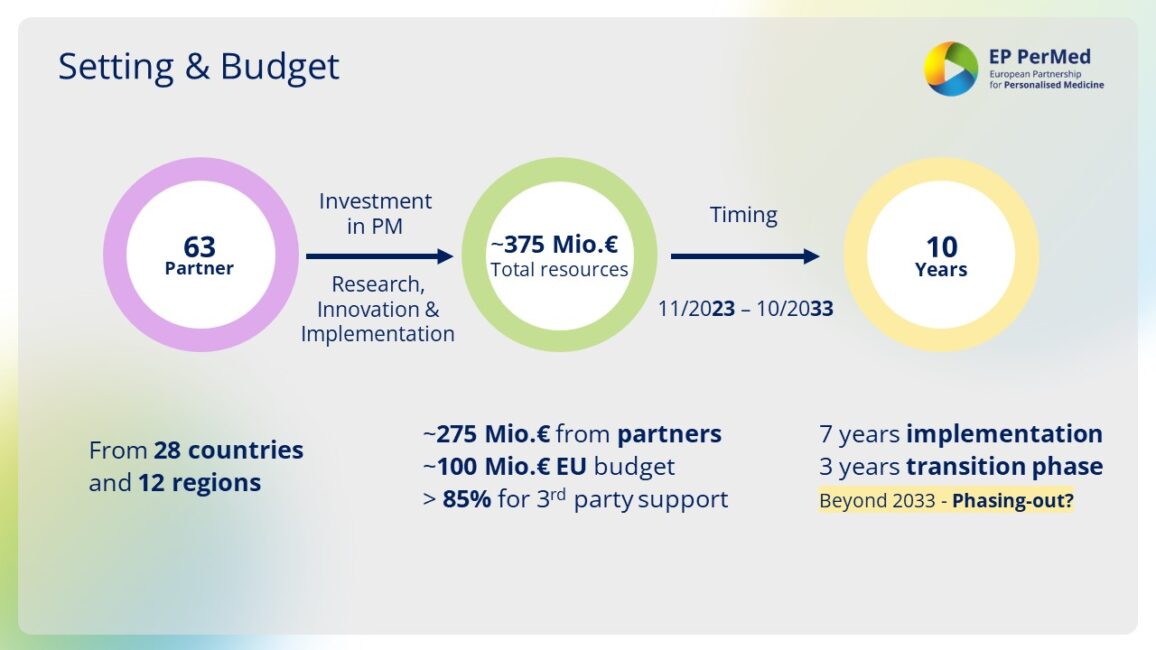
The European Partnership for Personalised Medicine (EP PerMed) is working to accelerate the development and implementation of personalised medicine approaches for the benefit of patients, citizens, healthcare systems and society. The current phase of EP PerMed as a co-funded European Partnership under Horizon Europe runs from November 2023 to October 2033. However, the partnership is already looking ahead. Its Phasing-Out Strategy outlines possible pathways to sustain EP PerMed’s structures, activities and impact beyond the current funding period.
The strategy is designed as a living document. It will be further developed in dialogue with EP PerMed partners, Member States, the European Commission, HaDEA and relevant stakeholders. Its aim is not only to prepare for different future funding scenarios, but also to ensure that the momentum created by EP PerMed can continue in the long term.
Future Scenarios for EP PerMed
The Phasing-Out Strategy describes two main scenarios for the future of EP PerMed after 2033. These scenarios are not final decisions, but provide a framework for discussion, planning and further development.
Scenario 1: A Partner-, Member- and Income-Supported EP PerMed
In this scenario, EP PerMed would continue without direct EU funding. The partnership would be supported by existing and future partners, members and additional income-generating activities.
EP PerMed partners could include ministries, funding agencies, foundations, charities and other organisations that contribute to joint transnational calls, provide in-kind support or help organise activities. In addition, the strategy opens the possibility of a broader membership model involving research institutes, infrastructures, medical societies, patient organisations, hospitals, payers, industry, SMEs, start-ups and other stakeholders active in personalised medicine.
EP PerMed Phasing-out Strategy
Such a model could help maintain the legacy, networks and core structures of EP PerMed. It could also allow the continuation of selected activities, including joint transnational calls, events, knowledge exchange, stakeholder engagement and strategic coordination.
Possible sources of support could include:
- annual partner and membership fees;
- in-kind contributions from participating organisations;
- support from foundations, philanthropic bodies or charities;
- conference and event fees;
- training, schools and educational activities;
- services, tools, knowledge resources and certification formats;
- venture creation, mentoring or innovation-support activities;
- cooperation with medical societies, research infrastructures, patient organisations and other European initiatives.
This scenario would require clear priorities, efficient governance and streamlined procedures. It would also need to address challenges such as limited budgets, reduced participation opportunities for some countries and organisations, and the need to safeguard the public-interest mission of the partnership.
Scenario 2: A Sustainable or Partially EU-Supported EP PerMed
In this scenario, the European Union and Member States would continue to support EP PerMed beyond 2033. This could take the form of continued co-funding, partial EU support or other European funding instruments.
A sustainable EU-supported model would allow EP PerMed to continue and further optimise its established activities, including joint transnational calls, implementation-oriented measures, innovation support, patient involvement, strategic alignment and international cooperation.
Even a reduced level of EU support could be essential to maintain the partnership’s core functions, coordination structures and added value for Europe. Continued EU involvement would also help avoid fragmentation of the personalised medicine landscape and support alignment between European, national and regional efforts.
This scenario would also enable EP PerMed to continue supporting ICPerMed as an international platform for policy dialogue, cooperation and exchange on personalised medicine.
Key Steps Towards Sustainability
The Phasing-Out Strategy sets out a timeline for further developing and refining EP PerMed’s future options.
In 2026, the strategy was discussed and adopted by the EP PerMed General Assembly. From 2027 to 2029, concepts for partner and membership fees, income-generating activities, budget optimisation and future support mechanisms will be developed.
The EP PerMed/ICPerMed Joint Conference and the finalisation of the updated Strategic Research and Innovation Agenda in 2027 will provide important opportunities to present and discuss sustainability options with the wider personalised medicine community. In 2029, EP PerMed plans to survey partners, interested organisations and stakeholders to assess their willingness to support the partnership through funding, annual contributions, in-kind resources or other forms of support. More detailed budget considerations will then be developed.
By 2030, EP PerMed aims to adopt a business and financial sustainability plan, including possible adaptations to governance structures and legal arrangements. In 2032, a refinement survey and further analysis will support the finalisation of the strategy before the transition phase begins.
The overall aim is to continue EP PerMed for at least another ten years beyond 2033 and, where possible, to establish sustainable support beyond a fixed deadline.
An Open Invitation to Future Partners and Members
The future of personalised medicine depends on broad, committed and long-term collaboration. EP PerMed therefore welcomes dialogue with organisations that share its vision and want to contribute to the development and implementation of personalised medicine.
Potential future partners and members may include:
- ministries and public authorities;
- national and regional funding organisations;
- healthcare institutions and hospitals;
- patient and citizen organisations;
- medical and research societies;
- research-performing organisations;
- research infrastructures and data initiatives;
- foundations, charities and philanthropic organisations;
- industry, SMEs and start-ups;
- payers, regulators and health technology assessment bodies;
- international initiatives and networks.
By joining or collaborating with EP PerMed, stakeholders can help shape the future of personalised medicine, contribute to European and international alignment, support innovation and implementation, and strengthen the bridge between research, healthcare systems and society.
Continuing the momentum
EP PerMed has already created strong momentum for personalised medicine across Europe and beyond. Its partners are committed to developing funding schemes, strategic activities, stakeholder engagement formats and implementation-oriented measures that can deliver long-term benefits for healthcare, society and the economy. The Phasing-Out Strategy is an important step towards ensuring that this momentum is not lost after the current EU funding period. It provides a framework for discussion, planning and joint action — and invites new stakeholders to become part of a growing European and international community dedicated to personalised medicine.
Interested in joining or collaborating with EP PerMed?
Organisations interested in contributing to the future of personalised medicine are invited to get in touch with the EP PerMed consortium and explore opportunities for cooperation.