

How can personalised medicine move from scientific innovation into routine clinical practice? A new publication by EP PerMed representatives in the European Medical Specialist Review identifies five key areas for action and highlights the importance of multistakeholder collaboration to advance implementation across European healthcare systems.
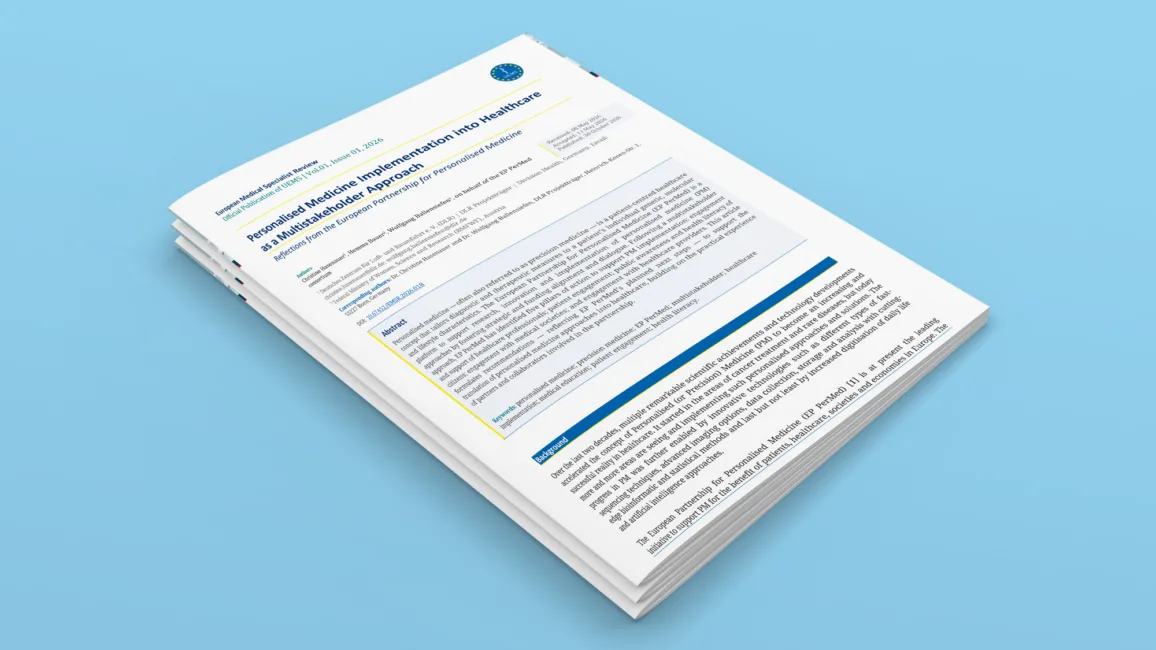
The article, “Personalised Medicine Implementation into Healthcare: A Multistakeholder Approach for Translating Innovation into Clinical Practice”, was published on 23 October 2026 in the European Medical Specialist Review, the peer-reviewed open-access journal of the European Union of Medical Specialists (UEMS). Written by Christine Hasenauer, Hemma Bauer and Wolfgang Ballensiefen on behalf of the EP PerMed Consortium, it explores the challenges of translating scientific advances into everyday healthcare.
While personalised medicine has made significant progress in recent years, expanding beyond oncology and rare diseases into other medical specialities, its implementation across European healthcare systems remains uneven. The authors argue that scientific and technological innovation alone is insufficient. Successful implementation requires coordinated efforts involving healthcare professionals, researchers, patients, medical societies, healthcare providers and policymakers.
Five Priorities for Successful Implementation
Drawing on the experience of EP PerMed, the publication identifies five complementary areas that are essential for bringing personalised medicine into routine healthcare:
- Professional education: Strengthening personalised medicine competencies through certified training, continuing professional development and integration into medical curricula.
- Patient engagement: Empowering patients and patient organisations to participate actively in research, innovation and healthcare implementation.
- Public health literacy: Improving citizens’ understanding of personalised medicine through accessible information, educational initiatives and targeted communication.
- Collaboration with medical societies: Strengthening cooperation to integrate personalised medicine into clinical guidelines, professional education and routine medical practice.
- Cooperation between healthcare providers: Promoting cross-border collaboration, peer-to-peer learning and the exchange of best practices between healthcare institutions.
For each area, the article discusses concrete opportunities for further action, ranging from expanding certified educational programmes to strengthening cooperation between European medical societies and healthcare providers.
Read the full publication: Personalised Medicine Implementation into Healthcare: A Multistakeholder Approach for Translating Innovation into Clinical Practice