

EP PerMed awardes the title of “Best Practice” (BP) in Personalised Medicine to the ‘Genetics-based Personalised Breast Cancer Prevention and Screening’ project as an example of successful implementation of a personalised risk-based breast cancer prevention into real healthcare services.
Through the BRIGHT project we have developed personalised, risk-based breast cancer prevention and screening using innovative genetic testing with polygenic risk score test. This helps us identify women at higher genetic risk and enable earlier, more targeted interventions – ultimately reducing late-stage diagnoses and preventable deaths. Our approach potentially saves 15 lives per 10,000 women.
Dr Peeter Padrik, oncologist

What health challenge sparked the development of this project?
Current breast cancer screening programmes are effective in reducing mortality among the age groups they target. However, by design, they are primarily age-based and therefore do not include younger women, some of whom may already have a significantly elevated risk of breast cancer. Importantly, there is no need to extend screening to all younger women. A more effective and sustainable approach is to identify those at increased risk and offer them personalised prevention and screening strategies based on individual risk profiles.
Breast cancer is the leading cause of cancer deaths in women. Every year adds 2.3 million new diagnoses and more than 660,000 deaths worldwide1. Breast cancer incidence and mortality rates have risen over the past three decades. Breast cancer morbidity and mortality can be reduced through primary and secondary prevention.
Primary breast cancer prevention involves lifestyle modifications such as a healthy diet, weight control, regular exercise, and limiting alcohol intake and prolonged breastfeeding, alongside medical interventions including hormonal preventive medication and risk-reducing surgery in very high-risk cases, all tailored to individual risk factors and developed in consultation with healthcare providers.
Secondary breast cancer prevention with mammography screening reduces mortality risk from breast cancer by 20-30%. European breast cancer screening programs typically target women aged 50 to 69 years. The primary method used is mammography, performed biennially or triennially. Current breast cancer screening is based on age alone and has been unchanged for decades, despite advances in science and published data. This is mainly driven by the complexity that updating national screening programs involve, as well as prioritising public spending focus. Such an approach, however, does not account for the wide variation in individual women’s breast cancer risks and disregards younger women with a higher risk, but also women over age 50 with higher risk levels who could benefit from more intensified screening.
Risk-stratified, or personalised, screening aims to tailor screening strategies to individual risk profiles, enhancing the benefits while minimising the harms and utilising resources more efficiently. Therefore, risk-based prevention and screening, in which a personalised risk assessment is used to inform screening practices, has been proposed as an alternative to age-based screening. Risk-based prevention and screening, however, requires easy-to-use and meaningful risk assessment tools backed-by feasible organisational service models.
How did you address this complex challenge?
Personalised Breast Cancer Prevention is a risk-adjusted approach aimed at minimising the impact of breast cancer by tailoring prevention and screening strategies to each woman’s individual genetic risk level and age, ethnicity. The game-changing component here is the introduction of polygenic risk score (PRS) technology into healthcare. PRS is the strongest independent risk factor for breast cancer and, unlike rare monogenic pathogenic variants (MPVs), which are carried by approximately 1.7% of the population, it affects a significantly larger number of women. We can say that based on PRS, 20% of women have a risk of breast cancer at such a level that they should start screening at a significantly younger age already based on current guidelines.
Therefore, the service developed is primarily indicated for cancer-free women aged 30 to 49 years (age before current standard screening).
The service begins with information for women and informed consents followed by PRS testing (AnteBC test). Based on test results, women, as well their medical professionals, receive from the digital decision support system written personalised medical plans with recommendations for screening and prevention. These include guidance on when and how to initiate breast cancer screening and effective preventive measures, such as hormonal medical prevention or health behaviour changes. The service also includes a family history questionnaire to determine whether the woman may require further testing for rare MPVs in genes such as BRCA1, BRCA2, and others.
Publication
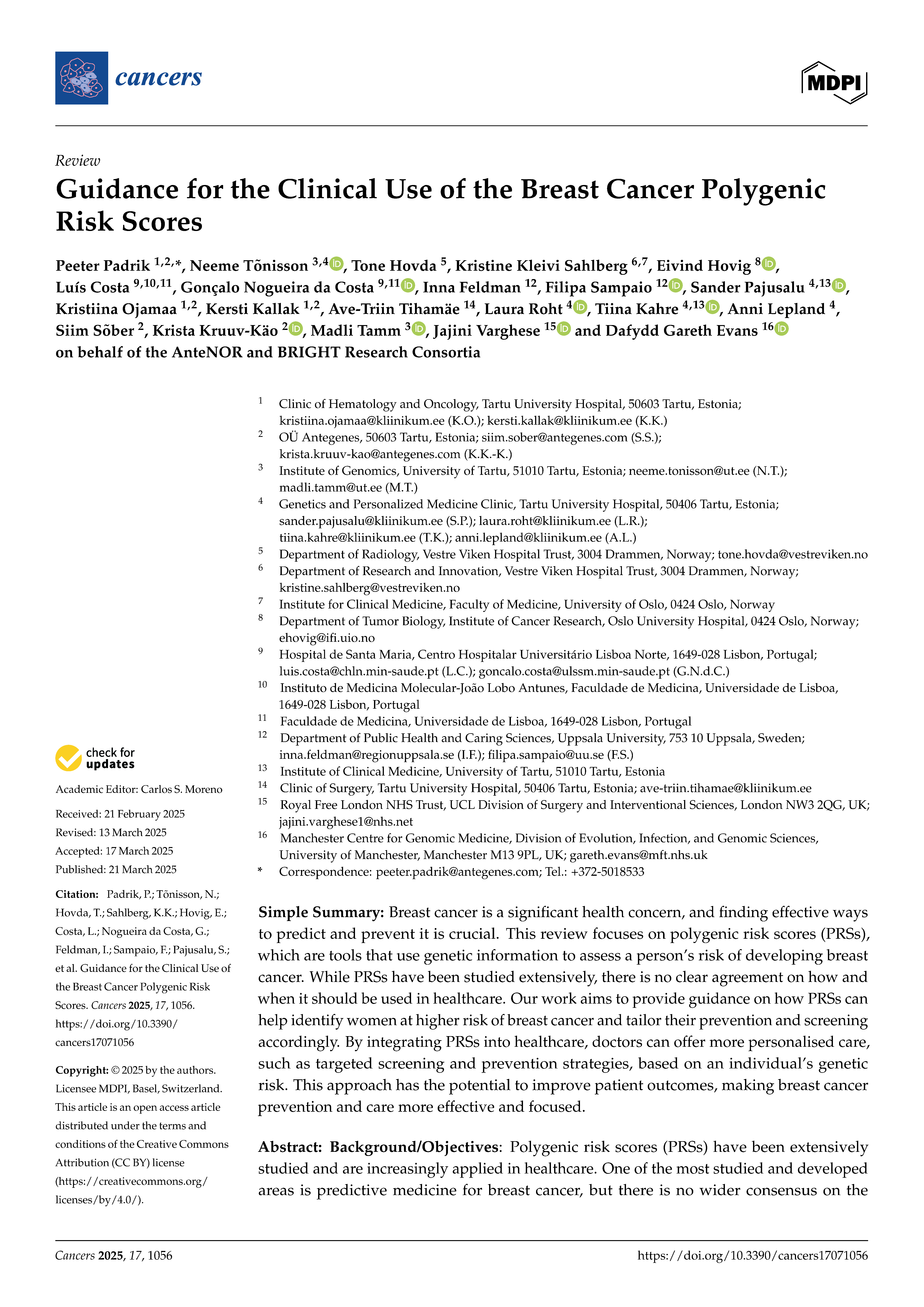
The international evidence base for the clinical use of breast cancer PRS is summarised in the peer-reviewed publication “Guidance for the Clinical Use of the Breast Cancer Polygenic Risk Scores”.
Women are provided with evidence-based medical recommendations that can be used within their national healthcare systems to proactively manage their breast health and start personalised screening in connection with local guidelines.
Personalised cancer prevention focuses on identifying younger women at increased risk of breast cancer who could benefit from a risk based prevention, screening approach, is associated with a 20-30% reduction in breast cancer mortality.
The EIT Health-funded BRIGHT implementation study demonstrated that among women aged 35-49, approximately 41.3% were found to have a polygenic risk exceeding the current average risk level of 50-year-old women, what is the agreed risk level for the start of current standard screening programs2. Of these, 15.5% commenced earlier breast cancer screening immediately, with others starting in subsequent years depending on their individual risk level.
The clinical application of personalised breast cancer prevention – via breast clinics, GPs, pharmacies, and digital telemedicine channels – is being tested and evaluated in the same BRIGHT project in Estonia, Portugal, and Sweden, led by University of Tartu. A very important aspect is that we showed in the BRIGHT project that population-based genetic risk screening can be implemented without traditional verbal pre-test and post-test counselling, using well-designed explanatory written decision support. Verbal pre- and post-test counselling is simply not sustainable for population-based applications.
The service has implemented the breast cancer polygenic risk score (PRS) test (CE-marked IVD-level AnteBC test by health-tech company Antegenes) as an innovation in healthcare but has also created a comprehensive personalised breast cancer screening service model. The service with the AnteBC test is currently utilised in the private healthcare sector of several European countries, including through digital telemedicine services. The service is also implemented in public healthcare in Estonia, currently as a pilot project, but from 2026, the Estonian Health Insurance Fund has formally committed to launching national PRS-based personalised breast cancer screening for all women at the age of 40, using a digital solution integrated into the Estonian e-Health infrastructure.
The service includes:
- Informed consent for service.
- Polygenic risk assessment using the CE-marked AnteBC test, incorporating genetic data along with age, population background, and ethnic information.
- Personalised medical plans with clinical recommendations for prevention and screening, based on an individual’s polygenic risk level.
- Family cancer history questionnaire to assess the potential need for testing rare monogenic pathogenic variants (MPVs). In the questionnaires, MPV testing indications are used according to each country’s clinical guidelines. If indicated, referral for a consultation with a medical geneticist and MPV testing is recommended. Where relevant, women can access further testing within their national healthcare systems, in line with country-specific guidelines.
- Implementation support, enabling women to follow personalised plans and begin screening and prevention services through local healthcare providers.
- Optional: additional medical counselling and consultations with healthcare professionals for those seeking further support or clarification.
- Optional: integration of PRS results with other clinical risk factors (e.g. mammographic breast density) using validated combined risk assessment models, such as CanRisk, where such services are in use. This approach enables more accurate and guideline-compliant clinical decision-making but is more complex and less feasible from an organisational perspective.
- Flexibility of access: the service is accessible both through physical health service providers (e.g. breast clinics) and as a digital telemedicine solution with home testing, offering broad, population-level reach.
The service enables more targeted and effective breast cancer prevention and early detection by identifying women at elevated risk, regardless of age, and offering them appropriate clinical interventions earlier than would be possible with standard age-based screening programmes. It also ensures that women with average or below-average genetic risk can avoid unnecessary procedures or anxiety, thereby making prevention more efficient and equitable across diverse healthcare systems in Europe. The service can be initiated either through healthcare institutions (e.g. breast clinics, general practitioners, gynaecologists, breast surgeons, medical geneticists, genetic counsellors) or as a digital solution via telemedicine, including home-based genetic testing.
How are questions of equity, diversity or gender taken into account in your Advances and learnings in Personalised Medicine (APM)?

The service is indicated only for women from the age of 30, as the risk of breast cancer in women and men differs significantly. The service is adapted to different ethnic groups and takes into account the risks of breast cancer in each population separately. The service creates more equity in the implementation of breast cancer screening, as it allows to find women younger than the current screening age group who, despite their age, have a higher risk of breast cancer, but who are currently excluded from screening. Approximately 20% of breast cancer cases are currently diagnosed in women under 50, who therefore never get to be screened. Personalised breast cancer screening makes screening more accurate and equal.
How does the programme collaborate with academia, private partners and/or health care providers in order to ensure its implementation in clinical practise and in the healthcare system?
The service is developed and tested in the EIT Health funded BRIGHT project by the consortium of public-private partnership. The consortium included: University of Tartu, Tartu University Hospital, Estonian Health Insurance Fund in Estonia, Uppsala County Council and Uppsala University Hospital in Sweden, North Lisbon University Hospital Centre in Portugal, IESE Business School in Spain and GE Healthcare in Hungary. The service is implemented in Estonia in partnership between Tartu University Hospital, the Antegenes company and Estonian Health Insurance Fund.
Does this project address ethical considerations, data protection and gender and diversity aspects? And what about health economics considerations?
The service includes all these components, as the service complies with healthcare regulations in Europe and has been introduced into clinical use.
Clinical benefit modelling and cost-effectiveness analysis have been performed for the service. A cost-effectiveness analysis using Estonian data assessed risk-stratified breast cancer screening from age 35, compared to standard mammography screening for women aged 50–69. The analysis focused on the impact of the PRS testing alone. Risk-based screening prevents 1.5 breast cancer deaths per 1,000 women screened and results in a gain of 3.85 quality-adjusted life years (QALYs), with an incremental cost-effectiveness ratio (ICER) of €37,755 per QALY gained per 1,000 women3. We have very similar data from the health-technology assessment in Norway.
The clinical utility of testing for monogenic pathogenic variants lies in empowering possible carriers with knowledge that enables earlier breast cancer detection through enhanced surveillance and life-saving risk-reducing measures, such as salpingo-oophorectomy or risk-reducing prophylactic mastectomy, significantly improving survival.
For the public healthcare use, the polygenic risk score and monogenic pathogenic variant testing required for the service, along with the subsequent breast cancer screening and prevention services, are financed as public sector services in Estonia by the Estonian Health Insurance Fund.
Do you believe this service has the potential to be scalable and/or transferable to another field or healthcare system?
Yes, the same service is implementable principally in all European countries. However, the components and organisation of the service may vary based on the specificities of each country’s healthcare system.
The BRIGHT Project Innovation Team has received for the development of personalised breast cancer prevention and screening service the second place in the European Institute of Innovation and Technology (EIT) Innovation Awards 2025, a one of outstanding European innovations. According to the EIT Awards jury, with the BRIGHT innovation we have essentially created a new standard for personalised breast cancer prevention. In addition, the jury highlighted its clinical applicability and strong impact on the future of cancer prevention in Europe.
- Ferlay J EM, Lam F, Laversanne M, Colombet M, Mery L, Piñeros M, Znaor A, Soerjomataram I, Bray F. Global Cancer Observatory: Cancer Today. Lyon, France: International Agency for Research on Cancer. Available from: https://gco.iarc.fr/today. 2024 ↩︎
- Tamm M, Padrik P, Ojamaa K, Paas A, Lepland A, Kruuv-Käo K, et al. Clinical Implementation Study of Genetic Risk-Based Breast Cancer Screening. Clinical Breast Cancer. 2025. ↩︎
- Sampaio F, Padrik P, Kruuv-Käo K, Lutsar K, Tõnisson N, Feldman I. Cost-Effectiveness of a Polygenic Risk Score Based Breast Cancer Screening Program in Estonia. Poster P18.018.A. European Society of Human Genetics Conference; Berlin 2024. ↩︎