

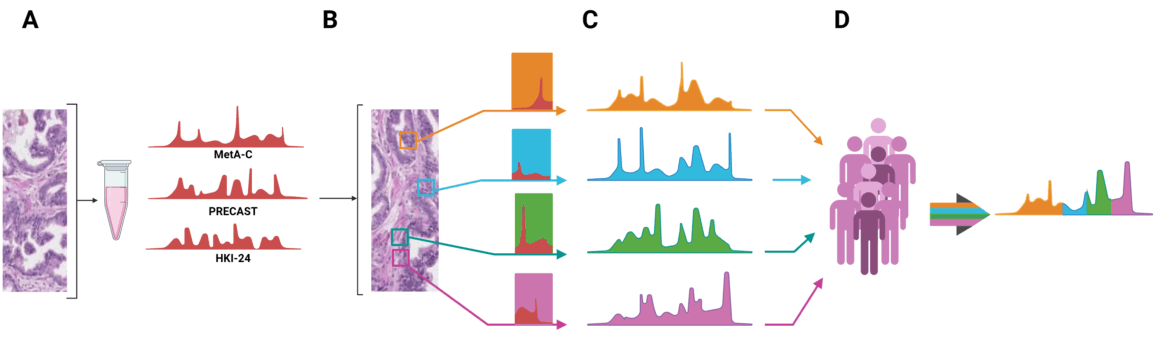
Markers for personalised medicine in prostate cancer (PC) are urgently needed. Although several candidate markers have been proposed, few have reached clinical use. As treatment escalation moves to earlier stages of PC, more patients may benefit from intensified therapy and improved survival, but also face unnecessary side effects due to the lack of reliable precision-medicine tools.
This project brings together tumour biology, technical innovation, bioinformatics, and clinical expertise across the Nordic countries, with the overall aim of developing spatially curated multiomics biomarker panels for precision medicine in PC. Prospective validation and clinical implementation through the Swedish SPRINTR infrastructure, combined with close collaboration with patient organisations, will ensure that health-economic and ethical considerations are embedded in this roadmap.
The project aims to: 1) use spatial multiomics analysis to refine biomarker profiles developed by consortium partners, accounting for clonality and tissue heterogeneity; 2) retrospectively validate optimised biomarker panels in well-defined patient cohorts and datasets; 3) employ tissue-based outcome measures following short-term treatment as a rapid approach to prospectively evaluate the therapy-predictive value of biomarker signatures; 4) use the SPRINTR infrastructure as a testbed for defined biomarker panels in real-world clinical settings; and 5) assess how precision-medicine decisions affect patients’ quality of life and develop a communication roadmap that supports shared decision-making.
By combining well-characterised clinical cohorts with complete follow-up, advanced spatial methods, and a clear pathway to national-level clinical implementation – while integrating the patient perspective – the project will provide a robust foundation for precision medicine in PC in the Nordic countries.
The consortium is still under contract negotiations and changes may occur.